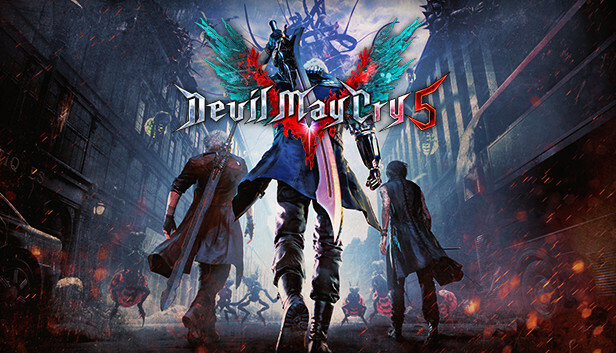
In 2013, Capcom handed the Devil May Cry franchise to Ninja Theory for a full reboot called DmC: Devil May Cry. It was a divisive game — some liked it, the hardcore fanbase did not. Then came Devil May Cry 5 in 2019, a direct continuation of the original series, and every debate about the franchise’s direction ended immediately.
DMC5 is not just the best game in the series. It is the best character action game ever made.
The Comeback Story
Devil May Cry 5 picks up after the events of DMC4, with a massive demonic tree called the Qliphoth erupting in the middle of Red Grave City, draining human blood to fuel a demon king’s rise to power. Nero arrives to handle it — but before he can do anything, a cloaked figure tears off his Devil Bringer arm and disappears.
That’s the setup. The story unfolds across three playable characters whose timelines cross and overlap, and the final act reveal — if you haven’t had it spoiled yet — is one of the most satisfying moments in franchise history.
Nero — Devil Breaker Beast
Nero plays closest to how he did in DMC4 but with one massive change — his supernatural arm is gone, replaced by a collection of mechanical Devil Breakers built by his mechanic ally Nico. Each one is a single-use weapon with its own ability:
- Gerbera — a rocket-propelled punch with massive knockback
- Overture — electric burst that stuns enemies and charges through shields
- Punchline — a detachable rocket fist that flies around the arena on its own
- Ragtime — slows time locally around a targeted enemy
- Tomboy — boosts Nero’s Red Queen sword and Blue Rose gun dramatically
The catch: Devil Breakers break on use or when you take a hit. You carry a stack and cycle through them, and Nico’s van scattered across levels lets you restock between fights. It adds a layer of resource management to Nero’s otherwise aggressive, rush-down playstyle that makes every encounter feel tactical.
V — The Wild Card
V is the most unusual playable character Capcom has ever shipped in a mainline action game. He doesn’t fight directly at all — instead he summons three demonic familiars and directs them from a distance:
- Griffon — a giant demonic bird that handles ranged electric attacks
- Shadow — a panther-like entity that transforms into blades, spikes, and portals for melee
- Nightmare — a massive golem summoned with Devil Trigger that devastates entire arenas
V reads poetry while his familiars do the work, jumping into close range only to deliver the finishing Nightmare attack once an enemy is staggered. It’s a completely different rhythm from Nero or Dante — slower, more deliberate, with a constant eye on familiar health since they can be destroyed mid-fight and need time to regenerate.
Some players love V immediately. Others find him repetitive over longer sessions. Both reactions are fair — he’s the riskiest design choice in the game, and Capcom committed to it completely.
Dante — Maximum Style
Dante returns with more weapons and style options than he’s ever had, and that’s saying something for a character already known for excess. His four combat styles — Trickster (evasion), Swordmaster (melee), Gunslinger (ranged), and Royal Guard (parry and counter) — are switchable in real time mid-combo, which means his skill ceiling is essentially infinite.
His weapon roster includes:
- Devil Sword Dante — the centrepiece, capable of creating phantom swords that orbit and attack independently
- Dr. Faust — a hat that spends in-game currency as ammo, but generates massive returns when you’re skilled enough
- Cavaliere — a motorcycle split into two buzzsaws used as melee weapons
- King Cerberus — a three-section staff that cycles between fire, ice, and lightning
Learning Dante properly is a long-term project. His moment where everything clicks — where you’re chaining style switches into weapon switches into Royal Guard parries — is one of the best feelings in action gaming.
What Works
- Three radically different characters — all equally satisfying to master
- Devil Breaker system adds constant tactical variety to Nero's combat
- V's familiar-based gameplay is unlike anything else in the genre
- Boss fights are some of the best in gaming history
- SSS ranking system rewards creativity, not just button mashing
What Doesn't
- V's gameplay can feel repetitive in longer sessions
- Story requires familiarity with DMC1 and DMC4 lore
- No co-op or multiplayer in the base game
The SSS Rank System
DMC5 judges your combat performance with a style meter running from D up through C, B, A, S, SS, and SSS. It rises when you use varied moves, keep combos going, and hit enemies with timing. It drops when you repeat the same move twice in a row or take damage.
SSS isn’t about being fast. It’s about being creative. A player who cycles through every tool in their kit will outscore a player who button-mashes faster every time. It’s the game’s way of rewarding mastery without making the base experience inaccessible — you can clear the campaign at B rank without any of this clicking, and then spend another hundred hours chasing the ceiling.
Boss Fights: A Masterclass
DMC5’s boss roster is the strongest in the series. Goliath, Cavaliere Angelo, Artemis, Geryon Knight, King Cerberus, Nidhogg, Nemesis, Gilgamesh, Malphas, Urizen, Vergil — each one has a distinct mechanical identity and pushes you to use different parts of your toolkit rather than letting one approach carry you through everything.
The final sequence of boss fights, in particular, is a sustained high that the game earns because of everything it built toward across the campaign.
Vergil DLC — Special Edition
The Special Edition, released November 2020 for PS5 and Xbox Series X/S (and as a paid update on PC), adds Vergil as a fully playable fourth character with his own campaign replacing V’s missions. Vergil uses the Yamato, Mirage Swords, and Beowulf in a high-precision, extremely high-skill playstyle that’s more demanding than any other character in the game.
If you’re on PS5 or PC, get the Special Edition. Vergil alone is worth the upgrade, and the next-gen version also runs at 4K/120fps, which makes the already-spectacular combat feel even better.
JoystickVerse Verdict
Devil May Cry 5 is the best the genre has ever been. Three characters with completely distinct combat philosophies, a banging soundtrack, boss fights that demand everything you've learned, and a style system that makes you feel like the coolest person alive when it finally clicks. Capcom didn't just make a great action game — they made the definitive one. If you call yourself a fan of action games and you haven't played DMC5, fix that today.